To kick off the fall season at the Walter Art Gallery, Heather Weller will be returning with a solo collection showcasing her creativity across mediums. Get to know the inspiration behind the show, Fable.
Heather Weller was born and raised in Phoenix, Arizona. She graduated from Arizona State University in 2021 with a Bachelor of Fine Arts and currently pursues higher education through the Master of Fine Arts program at ASU. During her career, Weller has had the pleasure of apprenticing for painter Alexei Butirskiy. She has also been featured in articles and publications such as PHOENIX magazine. Weller has exhibited across Phoenix but marks her solo show, Delusions, at Walter Art Gallery in 2023 as the most notable.
Weller is a painter who explores themes related to the human condition through figure and still life paintings. She aims to give life to the inner world of trauma and conflict. The history and art of the classical world remain a reigning influence on Weller’s work. She draws inspiration from time periods such as the Renaissance and Baroque eras.
We ask Heather:
1. What is your background as an artist?
My journey as an artist has been long and fortunately consistent. As a child, I was interested in all manner of creative endeavors, though I came to enjoy baking and cake decorating early on. Naturally, I envisioned this as the perfect career path, both creative and realistic. When I reached high school, I was disappointed to find out that my counselor had placed me in an intro to art class rather than culinary arts, which was full. Having no other option, I stuck with the art class, and for the next three years of high school, I took AP art, where I fostered my interest in painting and realized that I wanted to continue in the arts.
After high school, I continued, graduating with a BFA in Painting and Drawing in 2021 from Arizona State University. During this time, I realized the capacity for art to act as a cathartic release from my experience with mental health struggles, grief, and trauma. Painting is now not simply something I can do but something that I have to do. I am fiercely dedicated to painting because I have the privilege of certainty that making art is my reason for being. That being said, the path I chose is not easy, and I am reminded of that daily. There are times I wish that I had chosen something easier, but I think I am naive to believe that it would work out. In the end, I strongly feel that I would constantly revert back to painting.
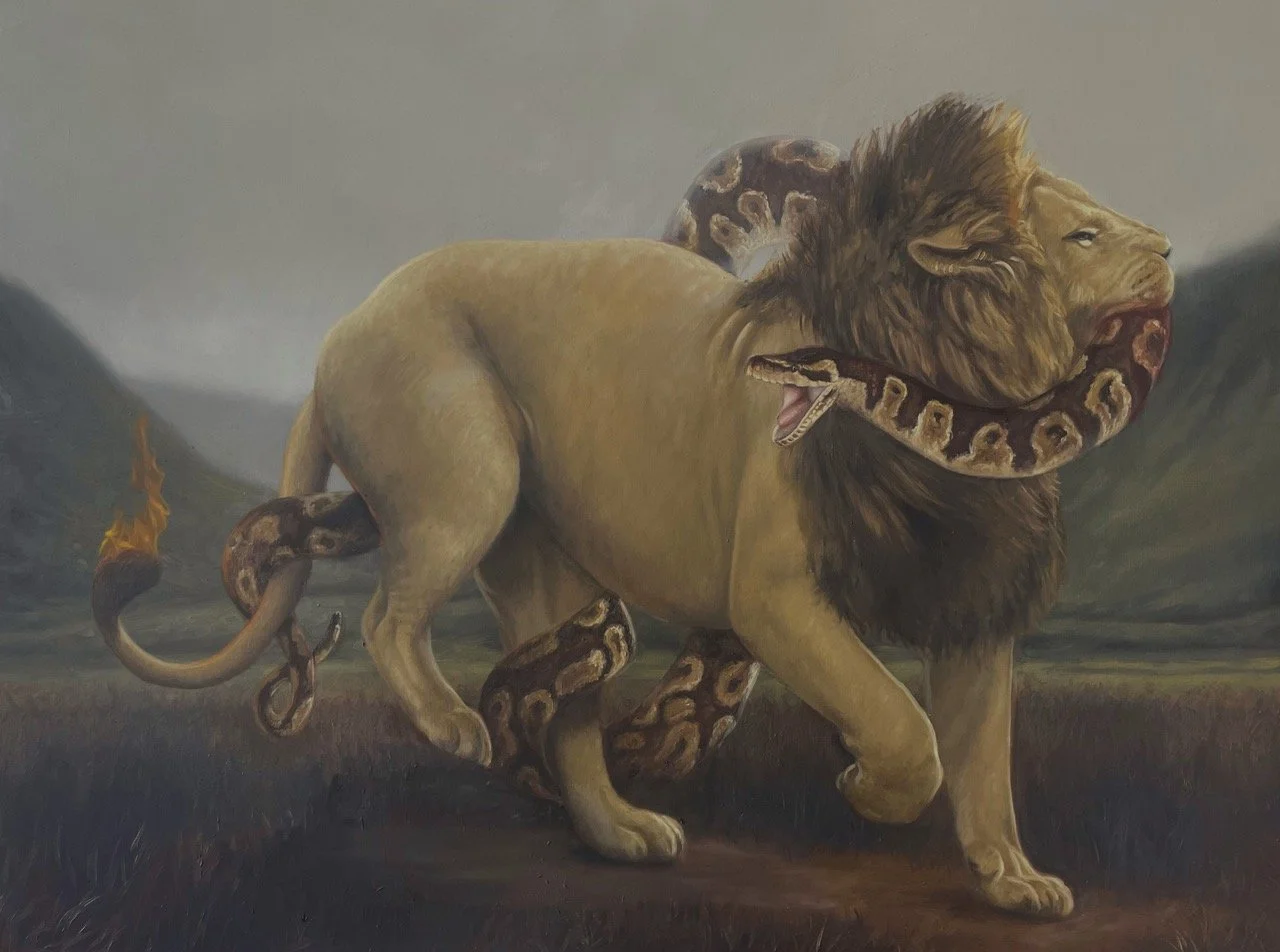
2. Why did you choose “The Lion’s Share” as the signature piece for Fable?
I felt that “The Lion’s Share” most strongly embodied the essence of Fable in a single piece. With this series, I considered suffering in relation to the human condition and encountered the work with a series of questions concerning the nature of our suffering. At the time I made many of these works, I was in a transitory state in life where every step forward came with a punch to the gut. Things started compounding on top of one another, and I fully understood the meaning behind “when it rains it pours”.
I turned to stories in hopes that they would help my understanding of the human condition and came across the original fable of the lion’s share, a story of wealth accumulation and greed. I took influence from the tale and changed the lion into a figure of compounding misfortune locked in a struggle with its own suffering personified as the snake. This piece speaks to the essence of the collected works. The human condition is suffering and it is our task to parse through, memorialize, and ultimately survive it in whatever way we can.
3. Are there backstories to each of your paintings, and if so does the story or imagery come first?
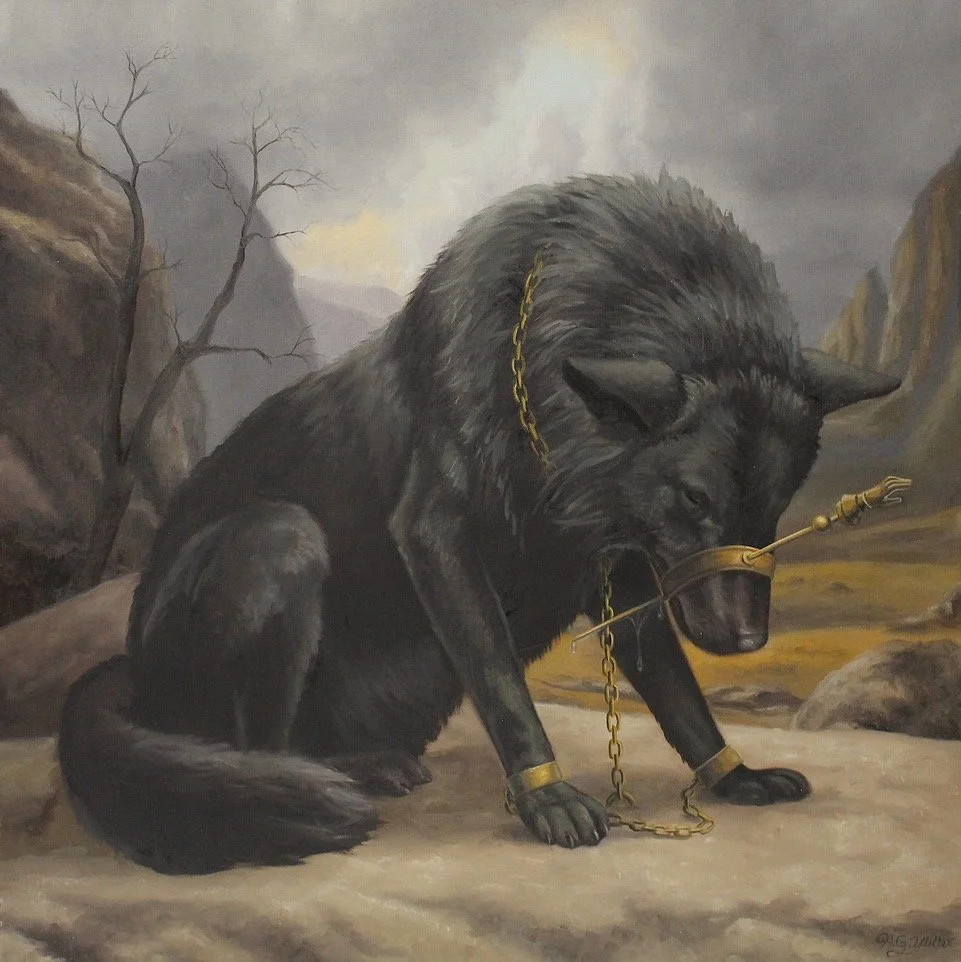
Both the gift and curse of living with OCD is that I never stop thinking. Painting is almost always at the forefront of my brain. I have considered the conception of ideas in depth lately for a series I am currently working on and arrived at the conclusion that the creation of the work that I make is equal parts relentless thought and chance. Sometimes, at the mercy of whatever void creation emerges from, the ideas just appear as an image. I would say that is the occasion 1% of the time. The rest of the time is a battle. When I approach a painting without the generosity of chance, I usually have to ask myself what it is I want to say. Then comes the planning. Maybe a lion, or Fenrir, or falcon. Each painting is a story of its own and often a meditation on that story. When I am in the studio making the piece, I am focused on that story as the thinking never stops. Painting at least gives translation to the thoughts.
4. What do you hope people will experience when walking through the exhibit?
I genuinely hope those who come to see Fable will recognize their own suffering and feel seen through the work. I think there needs to be a space in which we allow ourselves to recognize our hardship, especially in a word that demands we bear it in silence. It is a noble thing to survive the worst that life has to offer, and Fable asks you to confront your suffering so that you can endure and move forward.
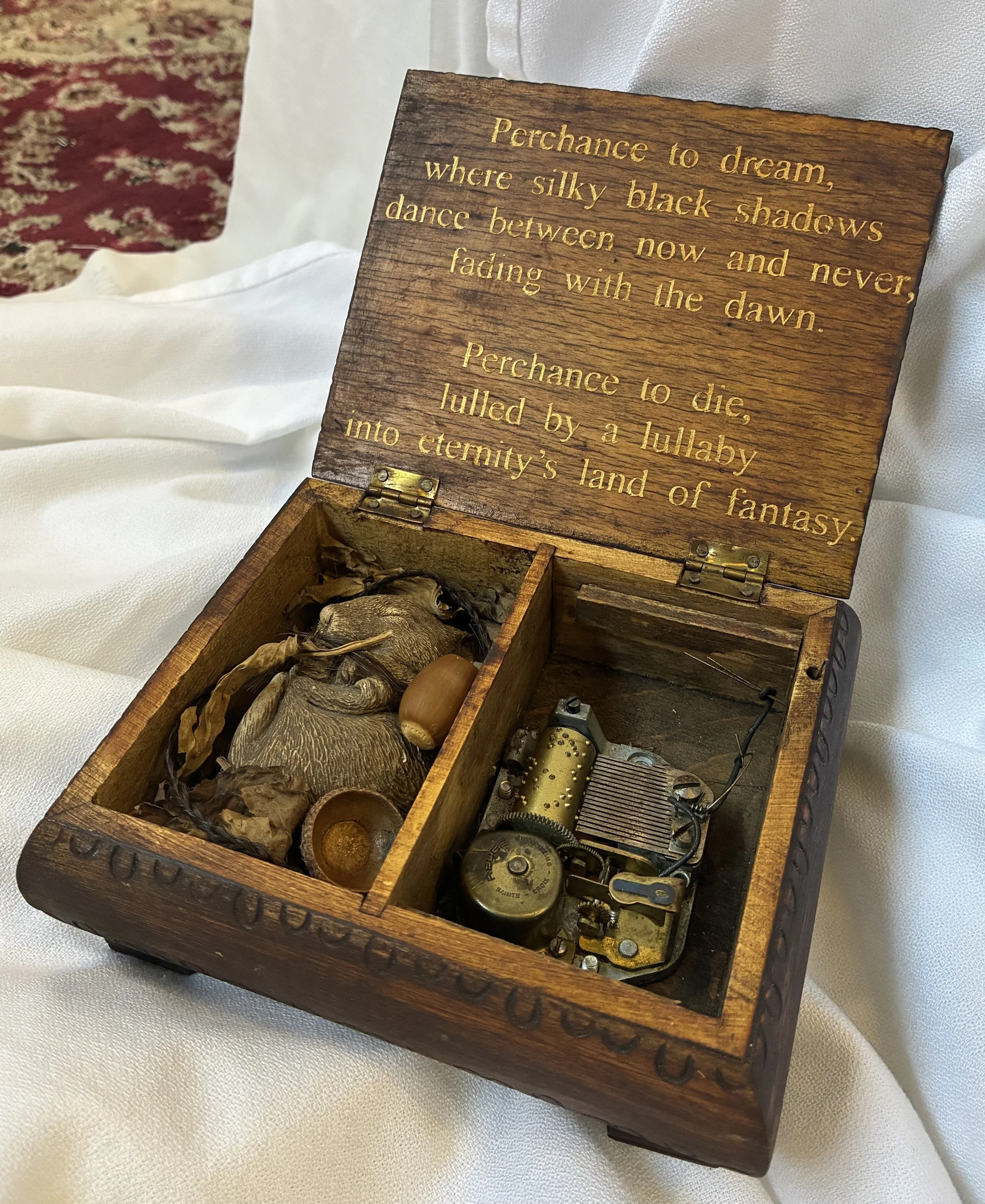
5. What is the story behind the wooden boxes?
I am always trying to push myself and my work to the next level; working with the boxes was an experiment with art and the written word. I find vulnerability in my writing, so, in an honest sense, the boxes were a way that I could showcase my writing and hide it at the same time. Writing is working its way into my practice more and more as time progresses, and it seems like it will feature heavily in a future series. The collection for Fable is a glimpse of what is in production.
I remember making the first box, “Do Not Give Me Hope”, after finding the box itself at a thrift store in Flagstaff. I was staying in Hotel Monte Vista for my birthday and thinking about what a tease hope can be. That is hope for a better future, happiness, etc. I wrote the poem in the hotel room, and the imagery came thereafter. I do believe the vulnerability behind the boxes speaks to how many of us suffer. Sometimes it is in silence, and we must open ourselves up to discover it or let it out. Other times our suffering is something we box away and harbor within.
6. How has your work evolved since your last show at Walter Art “Delusions” in 2023?
Much has changed since 2023, and much will continue to change. I believe through my collaboration with Walter Art, the public gets to watch as I solidify my footing as an artist. Delusions, focused on the work of the subconscious and story. I was just beginning to understand my style and the place that surrealism had in my practice. In everything I do, I always aim to improve.
Over the past few years since "Delusions" in 2023, my concepts and ideas have strengthened, and I feel I have a deeper understanding of myself and my work. Fable takes my fascination with the human condition to a new depth. I believe that the questions are deeper, the work is more cohesive, and my presence is bolder than before. I know my work will only continue to grow and evolve, especially during my graduate studies, and I think it is an honor to be able to share my growing practice.
7. Do you have items in your studio that you use to create an atmosphere when you paint? (If you’re comfortable including a picture of the item(s) that would be great but not required!)
The atmosphere that I work in is crucial for me. Having a “vibe” that correlates well with the work is non-negotiable. I need to feel comfortable and inspired in the place that I work, and my studio always reflects this need. I am inspired by everything antique and vintage. I am of the belief that vintage, handmade furniture will always be better than IKEA. I need things that have soul. Around my studio, I also have little pieces of inspiration from bones and skulls, books, to family portraits. I feel that a proper environment really is a must for artists, especially visual artists. We need things to look at, touch, and respond to.
8. Is there a person, place, or experience that inspires you?
Throughout my life, I have experienced a great deal of grief and loss. For a long time, I thought it best to just move on from the people I have lost so as not to dwell on the past. I am reconsidering my decision about this approach and working through grief with my most recent work. I find inspiration in the people I have lost and their stories. I now feel a need to preserve that memory.
The experience of grief in general also inspires the work I make. I channel that hardship onto canvas as a catharsis. Suffering is the most profound presence in my life, thus the nature of the work. I understand that the imagery I make is challenging for some who have never felt the depths of emotional trauma. I am often asked why I don’t paint things that are happy, and the answer is I would if one day the happiness outweighed the turmoil.
My most prominent inspiration for Fable was the natural world. Animals have a way of suffering in silence that I resonate with. Most people feel like the answer to enduring pain is to endure it in silence. We become animalistic in that sense as we put on a brave face to distract from any perceived weakness. I believe this is one of the reasons why animals are featured in folklore and legend so prevalently. The message is usually a description of the many ways we as humans can expect to suffer. These stories teach us how to do so in silence. At least for me, staying quiet never works. Fable asks you to confront your own pain and find a better way through it.
See Fable by Heather Weller in person! This is showing at Walter Art Gallery from September 18–October 16, 2026. Join us during our Third Friday events or email gallery@thewalterhive.org to schedule a viewing.
